

Fond: Ministry of Education of The Kingdom of Yugoslavia
Signature: АЈ, 66
Number of pages: 3
Publish date: 01.08.2026.
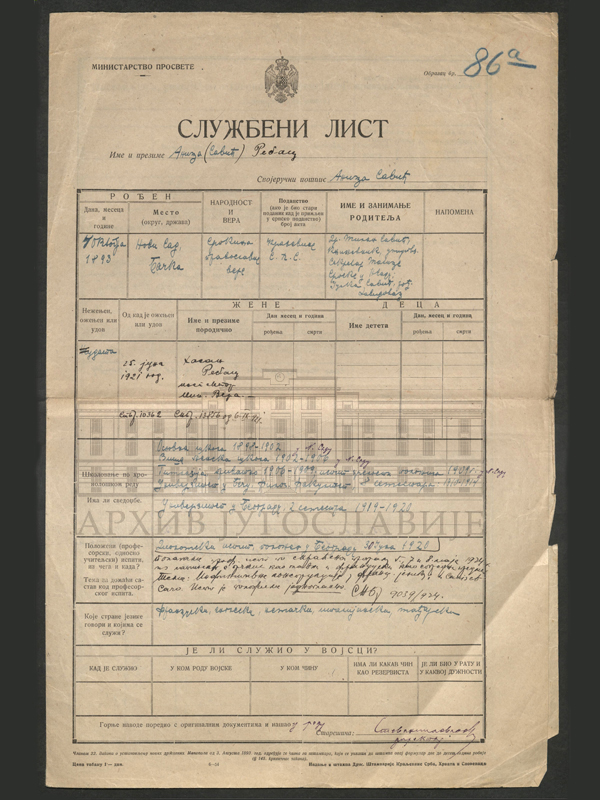
Official records and personal files represent primary archival materials that directly shed light on the professional paths of individuals and, as such, are of special importance primarily for the time period in which the young Kingdom of SCS/Yugoslavia was developing in all its potentials during difficult post-war times.
For this occasion, we have chosen the Official Record of Anica Savić Rebac, a prominent representative of the Serbian intellectual elite at a time when higher education for women was not a common occurrence.
Anica Savić Rebac was born on October 7, 1893, in Novi Sad, to father Dr. Milan Savić, writer and secretary of Matica Srpska, and mother Julka Savić, born in the distinguished Davidovac family, as a Serb of the Orthodox faith. She was married to Hasan Rebac (since June 25, 1921), inspector of the Ministry of Confessions.
In addition to biographical data, her Official Record sheds light on the course of her education and professional qualifications. Data on her education state that she completed Elementary School in Novi Sad (1898–1902), as well as the Higher Girls' School (1902–1906). She attended gymnasium privately (1906–1909) and passed the Matura exam in Novi Sad (1909). She attended the Faculty of Philosophy of the University of Vienna for eight semesters (1910–1914) and the University of Belgrade for two semesters (1919–1920).
The record also preserves the information that she passed her diploma examination in Belgrade (on June 30, 1920) and the professorial examination within a shortened period on May 7 and 8, 1924, with Latin and Greek as her main subjects, and French as a minor subject, with the thesis "Infinitive Constructions in the French Language: Canis et Caro". She passed the exam "unanimously", as evidenced by the record number in the corner of the document SNB 9039/924, by which she acquired the status of a secondary school professor.
Anica Savić Rebac was a polyglot and was characterized by a high degree of multilingualism. In her official record, she stated that she spoke French, English, German, Italian, and Hungarian.
She published poems and literary studies in various magazines. Above all in Brankovo Kolo, a famous magazine for literature, art, and culture published in Sremski Karlovci, in which she published her first poems and translations as a very young girl; in Bosanska Vila, then Književni Jug, in which she was a regular contributor from 1917 to 1925, together with Miloš Crnjanski and Ivo Andrić; then Dan, an avant-garde magazine she founded and edited in Belgrade together with Ksenija Atanasijević, as well as Srpski Književni Glasnik, the leading and most prestigious literary magazine of that era in Serbia. In the document, she also stated that she was preparing a Collection of Poems at that time.
She was also a member of Matica Srpska, as well as the Society for the Serbian National Theatre, the oldest professional theatre among Serbs. Given that her father, Milan Savić, was the long-time manager of this theatre, Anica was deeply connected to this institution from childhood. Bearing in mind that Milan Savić, in addition to being the long-time secretary of Matica Srpska and editor of Letopis Matice Srpska, was also a prominent translator whose pen produced the translation of Goethe's Faust into Serbian, it is not unusual that his daughter Anica, growing up in an atmosphere of original literary creation, herself translated Byron at the age of fifteen.
In addition to the described biographical data, this document also gives us an insight into the course of her professional service for the period 1920–1926.
Upon graduation, and after "taking the oath", which was a regular practice and a mandatory legal condition for working in state service, in 1920 she began working as a probation teacher (suplent) at the Girls' Gymnasium in Novi Sad. Then, by a Decree from 1922, she was appointed as a probation teacher at the Third Girls' Gymnasium in Belgrade, and in 1924, having passed the professorial examination, she was promoted from the status of probation teacher to professor. Furthermore, the course of her service followed the usual advancement into higher categories, for which data are recorded up to 1926.
The autograph character of this document is crucial as a scientifically relevant and primary source, indispensable in the biographical reconstruction of the life and work of Anica Savić Rebac — one of the most erudite creators of Serbian culture, a classical philologist, translator, and thinker whose opus holds a special place in 20th-century European humanism.
Prepared by: Đurđija Borovnjak, Senior Archivist, Vidosava Eraković, Senior Archivist